Bayswater's Find of the Week on the Used Book Floor Blog

Friday, July 27, 2018

For the Birds


     Our find on the used book floor this week is for the birds – at least, it is all about the birds.  The keeper of our find was a copy of “Birds of North America: A Guide to Field Identification” book that was printed in 1966.  Full of illustrated pictures and descriptions, “Birds of North America” provides 325 pages of information for the interested bird watcher from any part of the continent.

     In the 52 year-old guidebook, we found a small dental appointment reminder card belonging to the owner of the book in April of 1980.  The owner (besides needing to make a dentist appointment) was clearly a bird enthusiast/watcher, as she made precise notes on the dental card about bird activity on one particular day of that year: April 17.  On this day, at precisely 7:00am, (which was observed by the watcher to be warmer than usual at 65 degrees, might we add) the bird enthusiast noted that she saw the following 11 birds out her window: a cardinal, dove, goldfinch, brown-headed cow bird, evening grosbeak, purple finch, chickadee, blue jay, titmouse, white-throated sparrow, and red-winged blackbird.  This was all during a morning cup of coffee!

   
  Now, we know what you are thinking…was this person confused with some sort of “Wild America” bird-themed TV program that may have aired that day?  Rest assured, this is not possible, as we researched and found that both “Wild America” and the popular PBS “Nature” series, trailblazers of their time, did not debut until two years later in 1982.  Wherever our mystery bird enthusiast/watcher was, (and we assume she was on the North American continent, hence the book) she was clearly experiencing a bird palooza of sorts.  Apparently April 17 of 1980 was a big day for our feathered friends!

      This date, however, was not the only one noted by our mystery bird watcher.  The enthusiast wrote small dates next to the illustrations of some of the birds throughout “Birds of North America,” as well, noting what month and year each bird was observed.  These notes actually began prior to 1980, as, for example, the Hairy Woodpecker was observed in February of 1976, the White-Crowned Sparrow stopped by for a brief snack near the pencil-wielding enthusiast in May of 1996, and the Rose-Breasted Grosbeak briefly posed for a viewing in April of 2004.  If you are keeping track yourself, this means that this copy of “Birds of North America” contains viewing dates and notes from over 40 years of bird watching by our observer and book owner.  That is pretty incredible and, we think, a small slice of history.

     The “Birds of North America: A Guide to Field Identification” book, complete with decades of notes and observations, can be all yours for a grand total of $3.00.  You can catch up with our previous finds of the week from the used book floor at bayswaterbooks.com and on facebook.  Better yet, stop by our store in Center Harbor and check out the used book floor for yourself!

Thursday, July 19, 2018

A Three-Dimensional Find

     This week’s find is our first that did not come directly from inside the pages of a book, but rather, it came from the box that the books were donated in. This means that our find is three-dimensional – how exciting!


     Sometime last week, a box of used books was donated and left near our front door while we were closed. The box held an entire set – 21 books - of famed author Patrick O’Brian’s bestselling historical novels set in the early 1800s on the sea in the Royal Navy. These nautical books center around the adventures of the same central cast of characters, most notably the Royal Navy’s British captain Jack Aubrey and his Irish friend, physician and intelligence agent, Stephen Maturin. Ever heard of the 2003 movie titled “Master and Commander” starring actor, Russell Crowe? It was based on O’Brian’s first book in his series with the same title and characters.


     As we sorted through the books, we came upon a small green plastic box. Inside the box we found, at first glance, what looked to be a pocket watch of some sort. Could this be related to the historical books, we wondered? Maybe it was used as a tool on the sea to help tell time, or perhaps it was a nautical heirloom! We might have gotten a little carried away, as a closer look at the pocket-sized find quickly dashed those thoughts/dreams when we noticed that it wasn’t actually a clock face, at all. After a little research, we discovered that the find was a measurement tool that looks like a pocket watch, but is actually a vintage drafting scale measuring wheel. What is that, you may ask? We were wondering, too.


     Used for drafting, map reading and blueprint reading/development, the Alvin 1114 (model name and number) consists of three dials: one that measures 1 inch increments up to foot, the second that counts the number of revolutions of the first dial from 0-10 feet, and the third that counts the revolutions of the second dial from 0 to 100 ft. Such an instrument could have been used by an engineer, land surveyor or architect (before the introduction, perhaps, of software programs that now complete the same tasks). We have no idea how old the measurement tool is or where it came from, but we have one clue that we are hoping you can help with.


     On the back of the Alvin 1114, we discovered three initials engraved into the metal: DWJ. Who is DWJ and how did their vintage measurement tool end up in our box of donated bestselling nautical novels? Do you have any ideas? We would love to return it to its owner, so if you are DWJ and you know what the heck we are talking about, give us a call or stop by to retrieve your tool. We feel the need to admit that, just to try it out, we may have measured a few things with it around the store (true confessions, here). You know, a Lake Winnipesaukee map, a book or two, the length of a salt and vinegar potato chip that we were snacking on…you get the picture.


     The set of Patrick O’Brian historical Royal Navy novels are yours for 2.99 each and if you are DWJ, we have a nifty vintage measurement tool (that looks like a pocket watch) for you, as well. You can catch up with our previous finds of the week from the used book floor at bayswaterbooks.com and on facebook. Better yet, stop by our store in Center Harbor and check out the used book floor for yourself!

Wednesday, July 18, 2018

Whowonnit?


     Here at Bayswater Books, we love a good mystery, and our latest find of the week on the used floor gave us a double dose of the genre, as both the discovery and the book it was found in qualified as a whodunnit (or, in this case, who "won" it).

     A 1987 copy of Agatha Christie's classic mystery novel, "Appointment with Death" was the scene of our crime, so to speak, and in it we found the most intriguing clue.  A lipstick stained, typewritten note or a napkin from a bar or hotel, you might ask?  No, ours is much better and far less of a cliche.  Are you ready for this?  We found a first place ribbon indicating "Best of Breed/Variety" from an American Kennel Club dog show that took place at the South Dade Kennel Club in Miami, Florida on June 4, 2006.  Not exactly reason to call Scotland Yard?  Ok, that may be true, but this ribbon launched a whole new mystery for us to investigate.

     Of course, we wanted to know more about who (meaning, what dog) won best in breed/variety.  If you have read any of our previous entries, you know this means that we’ll pull out all of the stops to find the answers we seek.  So, after scouring the internet and coming up short, we decided to call a top official of the South Dade Kennel Club in Miami and ask her what she knows.  Why not, we thought?

     First, let’s just say that Paula (that is her name) was just a wee bit surprised to hear from us.  As a matter of fact, we could hear her excitedly exclaiming to individuals in the background that “a store in New Hampshire found a Best of Breed ribbon of ours in a book, sort of like finding a message in a bottle!  How great is that?”  She then proceeded to teach us a little about the world of AKC dog shows in an effort to narrow our search.

     We learned that over 190 AKC registered breeds are entered into an average show and each breed is also classified into a group that represents the characteristics and function of all dogs (Terrier, Toy, Working, Sporting, Non-Sporting, Herding, and Hound).  Once a dog has won Best in Breed/Variety, it is then entered into the next round, or the group level, to compete against the other breed winners in its grouping.  The seven winners of each grouping then compete for Best in Show.  That is a tough climb to the top, we say.

     Paula told us that because our ribbon did not state what breed our winner was, we do not know if he/she won Best in Group in the next round or, better yet, if he/she were able to capture the Best in Show title.  Could it have been a Chihuahua?  What about a Bluetick Coonhound?  Maybe a Mexican Hairless dog?  We will never know, but on behalf of the staff here at Bayswater, we would like to congratulate Fido (or Max, Fluffy, Buddy, Lucky, Princess, etc.) on his/her Best of Breed/Variety win and hope that he/she went on to dog show greatness (and a life of endless treats and companionship, of course). 
      
     The 1987 copy of Agatha Christie’s “Appointment with Death” (with the winning ribbon) can be purchased here at Bayswater for the price of $6.99.  You can catch up with our previous finds of the week from the used book floor at bayswaterbooks.com and on facebook.  Better yet, stop by our store in Center Harbor and check out the used book floor for yourself!

Thursday, July 12, 2018

The Joy of Cooking & Investing

     This week, our find on the used book floor” starts off with an innocent, 65 year-old cookbook, but ends in a tale of financial fraud and corporate greed. The keeper of our find was a 1953 printing of “The Joy of Cooking” and this is where our story begins.

     Hidden in the pages of the cookbook was a 1983 investment report from the Prudential-Bache Securities financial company. It belonged to a woman in Reading, Massachusetts, (the owner of the cookbook) and detailed how much her investments were earning. When our cookbook owner received this notice, however, she did not know that only three years later, Prudential-Bache would become the focus of the largest financial scandal of the decade. More than 300,000 individuals, most of them elderly and on fixed incomes, lost millions of dollars by investing in limited partnerships that were anything but safe, as Prudential-Bache assured that they would be.

 
 At the time that this investment report was printed, Prudential-Bache employed a wealthy and grandiose man by the name of Clifton S. Harrison. Harrison carried a hidden, troubled past unknown to Prudential-Bache investors such as our Reading, Massachusetts, woman: a past that included a financial fraud conviction. It was Harrison’s deals (sold by countless brokers to unsuspecting clients) that would line the pockets of Prudential-Bache to the tune of millions, while bankrupting the life savings of those who invested. According to the Chicago Tribune in 1995, Prudential-Bache, now known as simply, Prudential, “cracked the foundation of the marketplace” by taking advantage of the consumer and destroying the faith of its investors. Perhaps that could be why their company slogan in the 1990s stated that “the most important thing we earn is your trust”. Good plan!

     Was our Reading, Massachusetts, cookbook owner one of the over 300,000 people who lost their savings? We do not know, but we certainly hope not. Instead, we would like to think of her making plum pudding (the recipe page that the investment card seemed to be marking) and enjoying the dessert with her family on a carefree evening.

     On a lighter note, we also feel that we would be remiss if we did not draw your attention to a particular section of the cookbook, itself. Towards the back, there is a chapter introducing the reader to the newly invented electric blender. Originally created in 1922 thanks to the invention of the small motor, the electric blender was beginning to make its way into households across America in 1953 (when this version of “The Joy of Cooking” was printed). Novel as the electric blender was at the time, the cookbook states that “only the ghost of an old-time medicine man could do justice to its usefulness and fascination” and that it will do everything but “put out the cat” as the chapter sought to encourage the reader to try one out. Made you smile a little at least, right?

     The 1953 copy of “The Joy of Cooking” (with its investment report and antiquated charms) can be purchased here at Bayswater for the price of $5.00. You can catch up with our previous
finds of the week from the used book floor at bayswaterbooks.com and on facebook. Better yet, stop by our store in Center Harbor and check out the used book floor for yourself!

Thursday, July 5, 2018

Diverse Interests


     This week's find on the used book floor reminds us booksellers, yet again, that the interests of readers are vast, diverse, and unpredictable (which is excellent!).  Illustrating this point for us is the combination of this week's find with the subject matter of the used book it was tucked in.

     We discovered a transcript from a 1985 Ken Burns non-fiction television documentary that aired on PBS - only his second one out of the now nearly 30 that the famed Emmy and Peabody award winner (and New Hampshire resident) has created.  This transcript was of Burns' one hour look into the culture of the Shakers and how they put their "hands to work and hearts to God" in the creation of their fine furniture, as well as their belief in pacifism, simplicity and perfection.  The 32 year-old document also states that the narrator of the documentary was none other than David McCullough, who is now one of America's most celebrated historical non-fiction authors and winner of two Pulitzer Prizes.  In 1985, the transcript was purchased by and sent to a Nashua, New Hampshire, resident for a grand total of only $3.00. 

     So, you might be thinking that we found this transcript in a book about furniture making, maybe, or something related to spiritual growth and living a life of simplicity.  Well, let’s just say that if we were playing the "hot/cold" game where hot means you are getting close and cold means the opposite, such a guess would fall somewhere in the realms of the arctic.  The transcript was actually discovered in the pages of a 1963 third edition reprint of the book, "A Classical Dictionary of the Vulgar Tongue".  Yes, there is a dictionary of English slang and this is it!  Even more surprising is that while this sounds like a modern-day creation, the Dictionary of the Vulgar Tongue was actually first published in 1785 - not long after the Dictionary of the English Language was originally released.

     How, exactly, does one compile and create the Dictionary of the Vulgar Tongue?  Believe it or not, the author, Captain Francis Grose, cruised countless waterholes "eating, boozing, and listening" as research for this slang dictionary.  While a great amount of the slang originally recorded over 225 years ago remains in our speech today, (to "kick the bucket" is to die, being "flush in the pocket" denotes one of wealth) many slang words and phrases may have been lost long ago without Grose and his Dictionary of the Vulgar Tongue (oh, no!). 

     See what we mean about vast and diverse interests?  Does one find the urge to flip through the Dictionary of the Vulgar Tongue while reading the documentary transcript all about the life of the Shakers?  One never knows.  What we do know is that the dictionary can be purchased here at Bayswater for the price of $20.00 and the transcript is all yours, as well.  You can catch up with our previous finds of the week from the used book floor at bayswaterbooks.com and on facebook.  Better yet, stop by our store in Center Harbor and check out the used book floor for yourself!

Thursday, June 7, 2018

The Peaceful (and Valuable) Bull


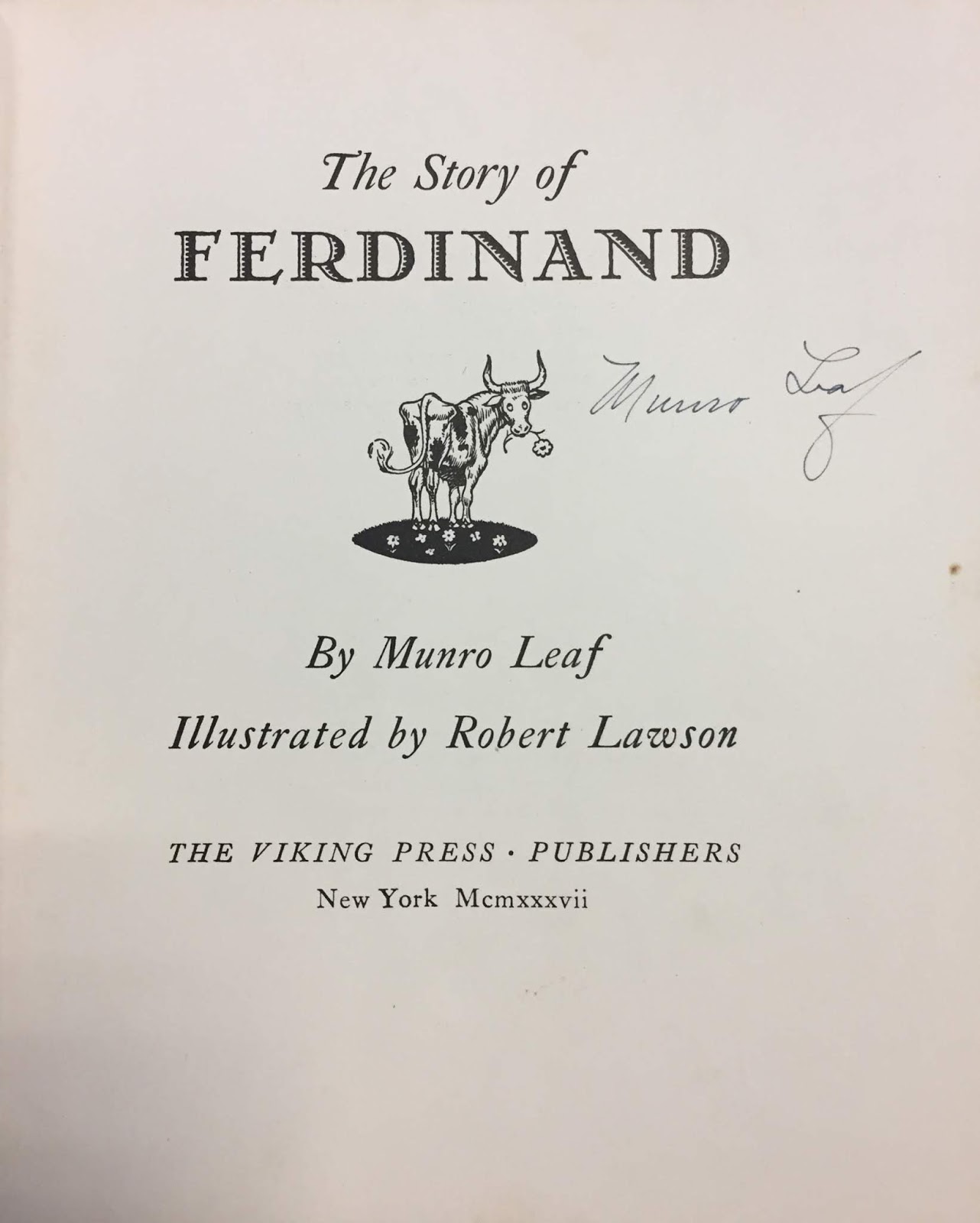
     We are so excited about our newest find of the week on the used book floor!  Nestled into the pages of a book (more to come on which one) was a New Yorker magazine “Talk of the Town” article from January 1, 1938, telling all about the (then) newly published phenomenon of a children’s book entitled, The Story of Ferdinand.  The American author, Munro Leaf, wrote the book about a bull named Ferdinand who likes to lie under a cork tree and smell flowers.  A peaceful bull, Ferdinand refuses to engage in any sort of a bullfight.  The New Yorker magazine article marvels at how the little sleeper of a story about the peaceful bull, Ferdinand, became the bestselling book in 1938 – even surpassing sales of the soon-to-be classic, Gone With the Wind, published around the same time 80 years ago.  This was particularly notable when considering the fact that this young children’s book was published during the financial struggles of the Depression.  


     Ok, so, more about Ferdinand in a moment, but now, the best part….where we found the New Yorker magazine article from 1938.  It was tucked into the pages of what appeared to be an older hardcover copy of – you guessed it - The Story of Ferdinand.  This was no ordinary copy of the now beloved children’s classic, however.  The book we found was printed in 1938 and is autographed – yes, autographed- by the heralded author, Munro Leaf, himself!  Yes, you read that correctly, and we think it bears repeating – we have a 1938 printing of The Story of Ferdinand that is autographed by the author!  Can you tell that we are just a little excited? To fully grasp our glee, you may need to read a bit more about the worldwide significance of this book and its main character.

     The Story of Ferdinand may have been written for children, but it quickly became a symbol across the world of peace and representation for the bullied.  Because the book was published during WWII, Hitler ordered all copies burned, as he declared The Story of Ferdinand to be “degenerate democratic propaganda”.  Stalin banned the book, as well, while Gandhi and the Roosevelts embraced the story.  As a matter of fact, the book was so loved by the American president that upon winning WWII, the United States airdropped 30,000 copies of The Story of Ferdinand onto Germany to promote peace! 
  
     Despite the global fervor and disdain, The Story of Ferdinand was actually written by Leaf with no agenda in mind at all.  He penned it in under 40 minutes to help create work for his friend and illustrator, Robert Lawson. In fact, Leaf chose a bull as his main character simply because he thought that other animals such as dogs, cats, horses and mice were overdone in children’s books at that time. Leaf would later marvel (and chuckle) at how his story would be printed in 60 different languages and become political and social ammunition for decades to come.  Over 80 years later, The Story of Ferdinand is still considered to be a popular children’s book today and was recently turned into a feature film.

     Leaf’s 1938 autographed collectable copy of “The Story of Ferdinand” is for sale here at Bayswater for $250 and includes the New Yorker article.  We will be back with our weekly edition of our finds by the end of June and in the meantime, you can catch up with our previous finds of the week from the used book floor at bayswaterbooks.com and on facebook.  Better yet, stop by the store in Center Harbor and check out the used book floor for yourself!

Thursday, May 3, 2018

Let’s Dance!


    Our latest find of the week on the used book floor is a true New Hampshire gem!  Tucked into the pages of a 1972 first edition, signed copy of Newt Tolman’s “Quick Tunes and Good Times” was a letter (typed on a typewriter, no less!) from the author to his cousin in the same year.  Who is Newt Tolman, you may ask?  Doesn’t ring a bell?  Well, if you are from New Hampshire or have interest in NH history, you will want to hear this one.   

     Tolman, a resident and member of the founding family of Nelson, NH, (pop. 4,200) was born in 1908 and helped to run the family farm that was later converted into a four-season resort at Tolman Pond in the same town.  He became an accomplished flute player and admirer of contra dance music (formerly known as square dancing before the term became known for being too “square”) throughout his young adulthood.  Contra dance had been around the Monadnock area since the mid 1800s, but lost favor when the waltz and ballroom dancing became popular in the 1840s. 

     Nelson, NH, became a contra dance revival location in the 1930s when former summer people and city residents came to live there full-time in response to the stock crash of 1929.  This new population of people was looking for new customs, and Newt Tolman and skilled musician Ralph Page were ready with their over 100 composed and reworked contra dance tunes.  Tolman’s book, “Quick Tunes and Good Times,” the holder of the letter we found, contained many of these musical selections.

The weekly contra dancing, complete with live music, became a staple in Nelson and by the 1970s, the Nelson town hall had become world famous for being the Mecca of contra dancing and music. Yes, you read that correctly – world famous! Some people even came to simply kneel while revering the dance floor.  For decades until his death at the age of 78, Tolman rarely missed the chance to play the alto and C flutes at the famous Nelson town hall contra dances.

     While the contra dance craze is not quite as popular as it was during Tolman’s heyday, the town of Nelson still hosts the weekly dance, complete with live music, every Monday night.  In fact, April 28 marked the 40th anniversary of the popular weekly event – an event that began in 1978 with the influence of Newt Tolman.  Some consider New Hampshire resident Tolman to be one of the world’s most influential contra dance contributors during the mid-twentieth century, and not only do we have his first edition signed book, but it contains a letter from him!

     Tolman’s 1972 “Quick Tunes and Good Times” is for sale here at Bayswater for $15.00 and includes the letter (of course).  Just a reminder that we will be publishing one blog at the beginning of each month until summer is upon us, but you can catch up with our previous finds of the week from the used book floor at bayswaterbooks.com and on facebook.  Better yet, stop by the store in Center Harbor and check out the used book floor for yourself!