Bayswater's Find of the Week on the Used Book Floor Blog

Thursday, June 7, 2018

The Peaceful (and Valuable) Bull


     We are so excited about our newest find of the week on the used book floor!  Nestled into the pages of a book (more to come on which one) was a New Yorker magazine “Talk of the Town” article from January 1, 1938, telling all about the (then) newly published phenomenon of a children’s book entitled, The Story of Ferdinand.  The American author, Munro Leaf, wrote the book about a bull named Ferdinand who likes to lie under a cork tree and smell flowers.  A peaceful bull, Ferdinand refuses to engage in any sort of a bullfight.  The New Yorker magazine article marvels at how the little sleeper of a story about the peaceful bull, Ferdinand, became the bestselling book in 1938 – even surpassing sales of the soon-to-be classic, Gone With the Wind, published around the same time 80 years ago.  This was particularly notable when considering the fact that this young children’s book was published during the financial struggles of the Depression.  


     Ok, so, more about Ferdinand in a moment, but now, the best part….where we found the New Yorker magazine article from 1938.  It was tucked into the pages of what appeared to be an older hardcover copy of – you guessed it - The Story of Ferdinand.  This was no ordinary copy of the now beloved children’s classic, however.  The book we found was printed in 1938 and is autographed – yes, autographed- by the heralded author, Munro Leaf, himself!  Yes, you read that correctly, and we think it bears repeating – we have a 1938 printing of The Story of Ferdinand that is autographed by the author!  Can you tell that we are just a little excited? To fully grasp our glee, you may need to read a bit more about the worldwide significance of this book and its main character.

     The Story of Ferdinand may have been written for children, but it quickly became a symbol across the world of peace and representation for the bullied.  Because the book was published during WWII, Hitler ordered all copies burned, as he declared The Story of Ferdinand to be “degenerate democratic propaganda”.  Stalin banned the book, as well, while Gandhi and the Roosevelts embraced the story.  As a matter of fact, the book was so loved by the American president that upon winning WWII, the United States airdropped 30,000 copies of The Story of Ferdinand onto Germany to promote peace! 
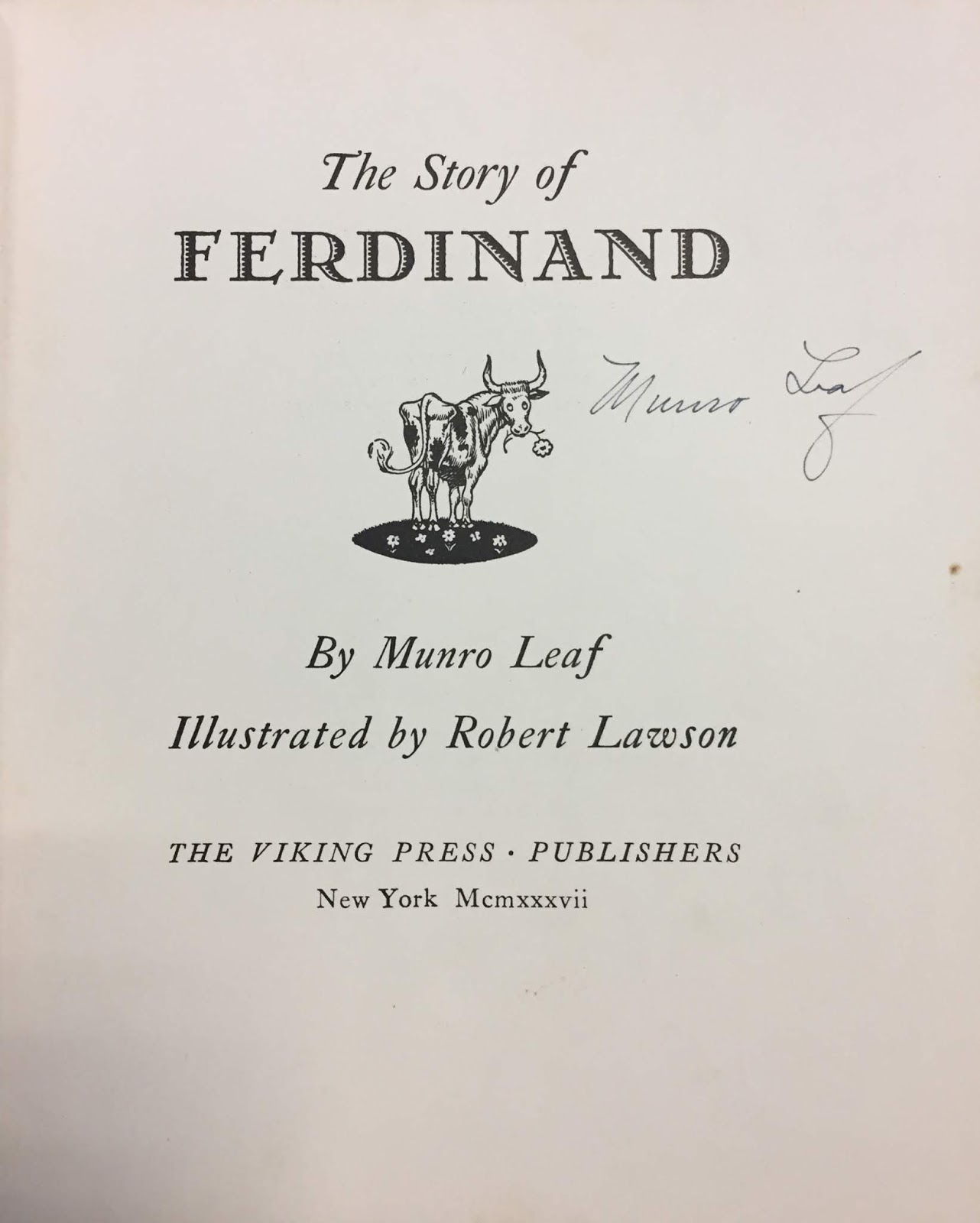
  
     Despite the global fervor and disdain, The Story of Ferdinand was actually written by Leaf with no agenda in mind at all.  He penned it in under 40 minutes to help create work for his friend and illustrator, Robert Lawson. In fact, Leaf chose a bull as his main character simply because he thought that other animals such as dogs, cats, horses and mice were overdone in children’s books at that time. Leaf would later marvel (and chuckle) at how his story would be printed in 60 different languages and become political and social ammunition for decades to come.  Over 80 years later, The Story of Ferdinand is still considered to be a popular children’s book today and was recently turned into a feature film.

     Leaf’s 1938 autographed collectable copy of “The Story of Ferdinand” is for sale here at Bayswater for $250 and includes the New Yorker article.  We will be back with our weekly edition of our finds by the end of June and in the meantime, you can catch up with our previous finds of the week from the used book floor at bayswaterbooks.com and on facebook.  Better yet, stop by the store in Center Harbor and check out the used book floor for yourself!

Thursday, May 3, 2018

Let’s Dance!


    Our latest find of the week on the used book floor is a true New Hampshire gem!  Tucked into the pages of a 1972 first edition, signed copy of Newt Tolman’s “Quick Tunes and Good Times” was a letter (typed on a typewriter, no less!) from the author to his cousin in the same year.  Who is Newt Tolman, you may ask?  Doesn’t ring a bell?  Well, if you are from New Hampshire or have interest in NH history, you will want to hear this one.   

     Tolman, a resident and member of the founding family of Nelson, NH, (pop. 4,200) was born in 1908 and helped to run the family farm that was later converted into a four-season resort at Tolman Pond in the same town.  He became an accomplished flute player and admirer of contra dance music (formerly known as square dancing before the term became known for being too “square”) throughout his young adulthood.  Contra dance had been around the Monadnock area since the mid 1800s, but lost favor when the waltz and ballroom dancing became popular in the 1840s. 

     Nelson, NH, became a contra dance revival location in the 1930s when former summer people and city residents came to live there full-time in response to the stock crash of 1929.  This new population of people was looking for new customs, and Newt Tolman and skilled musician Ralph Page were ready with their over 100 composed and reworked contra dance tunes.  Tolman’s book, “Quick Tunes and Good Times,” the holder of the letter we found, contained many of these musical selections.

The weekly contra dancing, complete with live music, became a staple in Nelson and by the 1970s, the Nelson town hall had become world famous for being the Mecca of contra dancing and music. Yes, you read that correctly – world famous! Some people even came to simply kneel while revering the dance floor.  For decades until his death at the age of 78, Tolman rarely missed the chance to play the alto and C flutes at the famous Nelson town hall contra dances.

     While the contra dance craze is not quite as popular as it was during Tolman’s heyday, the town of Nelson still hosts the weekly dance, complete with live music, every Monday night.  In fact, April 28 marked the 40th anniversary of the popular weekly event – an event that began in 1978 with the influence of Newt Tolman.  Some consider New Hampshire resident Tolman to be one of the world’s most influential contra dance contributors during the mid-twentieth century, and not only do we have his first edition signed book, but it contains a letter from him!

     Tolman’s 1972 “Quick Tunes and Good Times” is for sale here at Bayswater for $15.00 and includes the letter (of course).  Just a reminder that we will be publishing one blog at the beginning of each month until summer is upon us, but you can catch up with our previous finds of the week from the used book floor at bayswaterbooks.com and on facebook.  Better yet, stop by the store in Center Harbor and check out the used book floor for yourself!

Thursday, March 1, 2018

Capturing Your Soul

     The weekend of July 14-15, 2007, was important for millions of people across the globe and it led us to our most recent find of the week on the used book floor.  Don’t recall those dates?  We have three words for you: Harry Potter movie.  Yes, July 14-15, 2007, was the premiere of the Harry Potter and the Order of the Phoenix movie that was based on the wildly popular book series.

     Tucked into the front cover of Jack London’s “The Call of the Wild and White Fang” compilation, our find was a movie ticket stub from July 15 of that year, admitting one adult to view the newest Harry Potter flick.  By now, you probably know how popular the Harry Potter movies were as they were released, so what, you may be asking yourself, is so special about this particular cinematic installment in the series?

      Harry Potter and the Order of the Phoenix was novel (a little literary pun fun) for another groundbreaking reason: it was one of the first movies to use the technology known as Soul Capturing.  This new cutting edge innovation allowed a computer to map a real person’s emotions, facial expressions, and movements and place them in a very real-looking computer created individual.  Basically, this meant that the newly created person/avatar would physically look the way that the computer programmer designed him/her to appear, but would act and move exactly as the actor who was mapped.  In Harry Potter and the Order of the Phoenix, Soul Capturing was used to create Grawp, Hagrid’s half-brother who is a giant, allowing the fictitious character to be created virtually while actor Tony Maudsley’s behavior, emotions, facial expressions, and movements were mapped onto the virtual giant (see pictures of Grawp and Maudsley below).


     The best part?  Soul Capturing software also introduced the ability to map an actor’s personality into a real person – living or dead.  This means that the movements, emotions and facial expressions of an actor such as Marilyn Monroe, dead for over 50 years, could be mapped onto a computer generated version of Monroe and, using the gathered information, the new Monroe could look and act like herself in a full length movie produced long after her passing.  Can you imagine where that technology could take us?  Actors would never have to worry about aging on screen, performers from vastly different time periods could appear together in movies and so much more because the technology now exists to “capture their soul”. We know what you are thinking – all of this discovered from the Harry Potter movie ticket stub. 


     London’s 2003 copy of “The Call of the Wild & White Fang” is for sale here at Bayswater for $4.99 and includes the ticket stub.  Just a reminder that we will be publishing one blog at the beginning of each month only during the winter months, but you can catch up with our previous finds of the week from the used book floor at bayswaterbooks.com and on facebook.  Better yet, stop by the store in Center Harbor and check out the used book floor for yourself! 

Thursday, February 1, 2018

1983

     This week’s “Find of the Week on the Used Book Floor” is all about the year 1983.  Think back…what do you remember about 1983, or 35 years ago?  It was the year of great landmarks for women, as American Sally Ride became the first woman in space and Margaret Thatcher won a landslide victory as Prime Minister of the United Kingdom.   Cabbage Patch Dolls were first beginning to be sold (with great success) and the final episode of M*A*S*H aired with a record number of 125 million viewers glued to the screen.  Here in New Hampshire, you may not recall much specifically from 1983, but one local Laconia resident’s makeshift bookmark during that time period gave us a little peek into an interesting (and valuable) part of NH history. 

     Nestled into the pages of a 1983 copy of John Steinbeck’s classic, “The Grapes of Wrath” was a bank deposit slip of a Laconia man whose account was at Indian Head National Bank in Laconia (“in Laconia” was part of the entire name of the bank).  The institution was founded in 1892 and existed until the year…you can guess this one…1983.  The bank deposit slip was from that very year, as well (somebody buy a lottery ticket, already!).

     Never heard of this bank?  Well, after existing for almost 100 years, it was merged with the Indian Head National Bank of Nashua in 1983.  During its existence, the Indian Head National Bank of Nashua printed 26 different types and denominations of national currency, some of which is very rare and valuable today.  This includes the hard-to-find $2 bill printed in 1875, $10 bills from the same year pen-signed by both the then- president and cashier at the bank, and original $50 national bank notes – of which only 35 are known to exist today in total from all banks in the country.  Find any of these rarities and you can go straight to Antiques Road Show without passing “go” and you’ll certainly collect a great deal more than $200!

     So, what happened to Indian Head National Bank of Nashua, the institution that is responsible for such valuable currency, you may be asking?  Ahh, corporate takeovers.  Fleet Bank purchased the institution in 1989 and in 2005, Fleet Bank was bought out by Bank of America.  While The Indian Head National Bank of Nashua (and Laconia) may be gone, it doesn’t mean, however, that you can’t still hunt for its valuable currency! 

     Steinbeck’s 1983 copy of “The Grapes of Wrath” is for sale here at Bayswater for $4.99 and includes the deposit slip.  Just a reminder that we will be publishing one blog at the beginning of each month only during the winter months, but you can catch up with our previous finds of the week from the used book floor at bayswaterbooks.com and on facebook.  Better yet, stop by the store in Center Harbor and check out the used book floor for yourself!


Wednesday, December 27, 2017

From Germany to New Hampshire

     If you have read some of our past “Find of the Week on the Used Book Floor” blogs, you know that we are always game to conduct any type of research that helps us to learn about our discoveries.  This week, however, provided our most challenging quest yet: translating German to English. Yes, our find this week is from Germany!

     Nestled into the pages of Anita Shreve’s 2013 paperback copy of “Stella Bain” was a ticket to SUC Bus Und Aquaria Gmbl. Translation?  In case you are not fluent in German, (and we certainly aren’t), we discovered that SUC Bus Und Aquaria Gmbl is an indoor/outdoor facility in Coburg, Germany, that boasts large swimming pools, waterslides, comprehensive diving facilities, saunas, wellness centers, and more.  In fact, for short, they are known as the SUC Aquaria und mehr, which means “aquarium and more” in German.  The ticket cost 1.60 euros (about $1.90 in dollars) and was purchased for one time use by an individual who visited the facility on August 8th of 2017.  What a journey that ticket has been on to get here to New Hampshire!

    
     What is particularly interesting about SUC Bus Und Aquaria Gmbl is its location.  Coburg, Germany, lies in the foothills of the Thuringian Forest and is located 80 miles west of the Czech border.  Unlike many areas of Germany, Coburg was barely damaged in World War II and as a result, it still contains most of the original historic buildings and castles, making the town a popular tourist destination.  We found it slightly notable that with all of the castles, theaters, historic parks, museums and churches to see, the individual who visited Coburg chose to go to the water park.  Maybe they had already experienced enough history for one day.

     We would be remiss if we didn’t tell you, though, that Coburg’s biggest claim to fame is being the possible birthplace of…wait for it… the hot dog.  Though The National Hot Dog and Sausage Council (yes, that really exists) claims that Frankfurt, Germany, is the birthplace of the hot dog, this claim is hotly disputed throughout the country, as many believe that a butcher in Coburg created the classic (some valuable trivia for you, right there).

     Shreve’s “Stella Bain” is for sale here at Bayswater for $4.99 and includes the ticket in German.  Perhaps you can do an even better job of translating it all!  Just a reminder that we will be publishing one blog at the beginning of each month only during the winter months, but you can catch up with our previous finds of the week from the used book floor at bayswaterbooks.com and on facebook.  Better yet, stop by the store in Center Harbor and check out the used book floor for yourself!


Thursday, December 7, 2017

Who is Who?

     Do you ever catch your mind drifting while you are reading a book?  You know, one minute you know what is going on, and the next minute you have no idea who is speaking or how a character is related to the story?  It happens to all of us and this week’s “Find of the Week on the Used Book Floor” was designed for just those moments.

     Our find was discovered in John Hersey’s 1950 book, “The Wall”, which tells the fictional story of 40 men and women who escape the Warsaw ghetto in the early 1940s.  Tucked into the front cover of the book was a small booklet written 67 years ago entitled, Cast of Characters.  The booklet lists the 60 characters that are in the book, along with their nationality and relationship to other characters.  Yes, you read that right – there are 60 important characters.  There are Officers of the Jewish Council, Leaders of the Underground Groups, Leaders of the Jewish Fighter Organization, and many other character groups. 

     Interestingly, at the top of the booklet, the author of the booklet wrote that “because of the unfamiliarity of East European names, readers of “The Wall” may find this occasionally useful for identification.”  Occasionally useful?  We don’t know about you, but with 60 characters, we think that this booklet would be strapped to our sides at all times during the reading of the book.  One brief drift of the mind and we would be in for a long reference check in the handy dandy booklet.  Heck - that would most likely happen without the stray of mind!

     Ironically, a review written in April of 1950 (as the book was first published) praised author John Hersey for “concentrating on a manageable group of characters.”  Really?  What, then, would be an unmanageable amount of characters?  We think that the author of that review, upon reading recent works of fiction, would be pretty disappointed in the average number of characters in contemporary novels.  We don’t know about you, but we have never read a book that contained 60 characters and was accompanied by a reference booklet to keep them all straight!  Really, you gotta love what we come across in the pages of our used books.

     Hersey’s “The Wall” is for sale here at Bayswater for $9.99, complete with the character reference booklet (and you are going to need it).  Just a reminder that we will be publishing one blog at the beginning of each month only during the winter months, but you can catch up with our previous finds of the week from the used book floor at bayswaterbooks.com and on facebook.  Better yet, stop by the store in Center Harbor and check out the used book floor for yourself!


Sunday, November 19, 2017

Say Cheese!

     Missing a favorite family photo, or snapshot of good times with friends?  We think you might be, too, and this week we just have to share our array of photos that have been discovered in the books on our used book floor.

     Now, before you start worrying that we might have a snapshot of you at that unfortunate family costume shindig you may have attended last week or month, rest assured; the majority of the photos we have found are clearly from decades past, most likely from the 80s and earlier because the photos have rounded edges.  All seasons are represented, as we have family photos in the woods with fall foliage in the background and a winter shot with those captured posing with a snowman they created.  Summer by the water is clearly favored, though, as snapshots of happy individuals in boats, near boats, or just the boats, themselves, were numerous.  We even have a snapshot of Fido (enter any dog’s name you want here) sitting on a boat.  What is it with the boats, huh?

     A few of our favorites are of a family christening event in 1950. These older photos depict the well dressed family members, including the children, in their formal attire at a church, all smiles.  We know that these pictures were taken in 1950 because the photos are dated, but no names or places were included in the inscription on the back.

     While we have found the time frames and clothing fashions very interesting (and we need to note that the shorts length for men has greatly improved since the 1970s), we also feel that each picture has story to tell.  Where are the people today that we see in the snapshots, and what has happened to them since?  Would they remember the day that was captured in these pictures?  Does it make you think of a day that you wish you could have a snapshot of to remember?

     Normally we tell you what book our “find” was discovered in and list its sale price, but in this case, the photos came from a number of books.  You will also be noticing that for the winter months, we will only be posting a column/blog during the first week of the month.  Fear not, however – we will be back on a weekly basis when spring arrives.

     To catch up with our previous finds of the week from the used book floor, you can always check us out at bayswaterbooks.com and on facebook, or stop by the store in Center Harbor and check out the used book floor for yourself!